


Introduction
The Common and Emerging Practices, a new series of resources from the Impact Principles, aims to capture key insights from notable trends in common practices in implementing the Impact Principles by our Signatories and highlight promising emerging practices and key gaps. By sharing these common and emerging best practices in impact management, we seek to elevate impact practice in the market and ensure that capital is mobilized at scale with integrity to drive meaningful impact outcomes.
The resources related to Common and Emerging Practices will be released in phases through website publication of initial drafts for each of the nine principles in series, followed by draft and final consolidated reports with stakeholder engagement.
Principle 6
Monitor the progress of each investment in achieving impact against expectations and respond appropriately
The Manager shall use the results framework (referenced in Principle 4) to monitor progress toward the achievement of positive impacts in comparison to the expected impact for each investment. Progress shall be monitored using a predefined process for sharing performance data with the investee. To the best extent possible, this shall outline how often data will be collected; the method for data collection; data sources; responsibilities for data collection; and how, and to whom, data will be reported. When monitoring indicates that the investment is no longer expected to achieve its intended impacts, the Manager shall seek to pursue appropriate action. The Manager shall also seek to use the results framework to capture investment outcomes.
The Components of Principle 6
- Monitor progress toward positive impact using the results framework, comparing achievement against expected impact for each investment.
- Use a predefined data collection process for sharing performance data with the investee, specifying frequency, method, data sources, responsibilities, and reporting channels.
- Pursue appropriate action when monitoring indicates an investment is no longer expected to achieve its intended impacts.
- Capture investment outcomes using the results framework.
Overview
Principle 6 positions impact management as a continuous and dynamic practice: tracking performance data, comparing results against expectations and responding to deviations. In doing so, it translates impact intentionality into accountability and bridges ex-ante expectations established in Principle 4 with learning and improvement processes under Principle 8.
Under Principle 6, investors are expected to monitor the impact performance of each investment against expectations, using a predefined data collection process shared with investees. Where monitoring reveals underperformance, investors are expected to take appropriate corrective action. Investors are also expected to capture not only outputs but outcomes, the real-world changes experienced by beneficiaries.
Challenges in the Implementation of Principle 6
Despite broad adoption of impact monitoring as a baseline practice, significant challenges persist in deepening the rigor, consistency and decision-usefulness of monitoring practice across the investor community. Key challenges include:
- Data quality, consistency and comparability. Monitoring systems are only as strong as the underlying data they rely on. Many Signatories — particularly those investing in emerging markets, early-stage companies or through financial intermediaries — face challenges in obtaining reliable, timely and comparable data from investees. Differences in how investees define, measure and report on impact indicators limit comparability across investments and portfolios, even where common frameworks are referenced. Limited sector benchmarks also make it difficult to assess how investment or portfolio-level performance compares to that of peers.
- Tension between standardization and contextualization. Investors face a recurring tension between the benefits of standardized indicators — which support portfolio-level aggregation, benchmarking and reporting — and the need for investment-specific indicators that capture the most relevant and material impact results in a given context. Over-reliance on standardized metrics risks missing what matters most for the specific investment, while over-reliance on bespoke indicators undermines comparability. Signatories are increasingly adopting hybrid approaches, combining a core set of standardized metrics with investment-specific indicators.¹
- Engaging investees in data collection and monitoring. Effective monitoring depends on the active participation of investees in data collection, yet investees’ capacity and willingness to provide consistent, quality data varies significantly. Reliance on self-reporting introduces risks of inconsistency, delays and selective disclosure. Approaches that co-design data collection with investees and connect impact KPIs to ongoing business management data can improve both data quality and investee buy-in. Some investors also support investees’ measurement capacity through technical assistance as well as by providing standardized data collection templates and portals.
- Connecting monitoring and decision-making. Despite increasingly structured monitoring systems, impact data is often generated at a distance from core investment processes and is not consistently integrated into investment decisions. This can limit the decision-usefulness of monitoring, confining its role to reporting and compliance rather than an active management tool. Strengthening feedback loops by embedding monitoring insights into investment governance, reviews and portfolio strategy will translate impact data into learning and improved impact performance, which is addressed under Principle 8.²
- Identifying and addressing underperformance. While Principle 6 explicitly identifies addressing underperformance as an expected practice, disclosure statements indicate significant variation in how formally and rigorously this is operationalized. To enhance the accountability function of monitoring and its utility as a management tool, investors will need structured processes for defining, triggering and documenting corrective actions, with clear thresholds as well as a defined range of responses, from enhanced engagement and revised targets to early exits.
- Measuring outcomes beyond outputs. Monitoring frameworks often emphasize inputs, activities and outputs rather than capturing outcomes of the changes experienced by end-beneficiaries. Measuring outcomes can be difficult, often requiring longer time horizons with greater uncertainty, more time and cost, and complex methodologies. While outputs are easier to measure and standardize, over-reliance on them can limit insight into whether investments are ultimately achieving their intended impact, particularly where there is no clearly articulated theory of change or evidence base validating the use of output indicators as reasonable proxies for outcomes. Third-party tools are helping close the gap for some investors, but broadly applicable approaches across diverse geographies, asset classes and impact themes remain challenging to implement at scale.³
- End-beneficiary voice and feedback loop. While intended beneficiaries are central to an impact thesis, their perspectives are systematically underrepresented in monitoring frameworks. A limited number of investors disclose meaningful beneficiary engagement or community feedback in impact measurement, which is typically operationalized through surveys, focus groups or third-party tools. The GIIN’s research has identified concerns about burdening end-stakeholders as well as lack of time and financial resources as key obstacles to doing so.⁴
- Portfolio-level aggregation. Portfolio-level aggregation presents both structural and technical challenges, as impact indicators do not aggregate naturally across diverse sectors, geographies and impact themes. Even when using the same indicator, methodological differences in data collection, varying units of analysis and differing underlying assumptions can make aggregated results challenging to obtain or misleading. Impact dashboards and data visualization tools can help consolidate and present portfolio data in a more accessible format, but they do not solve underlying data quality and misalignment issues and can create a misleading impression of precision and confidence that the underlying data does not support.
Key Observations in the Implementation of Principle 6
Across disclosure statements, most Signatories demonstrate established approaches to impact monitoring under Principle 6. While levels of rigor vary, clear patterns are emerging in how investors are structuring, operationalizing and deepening their monitoring systems. Notable observations include:
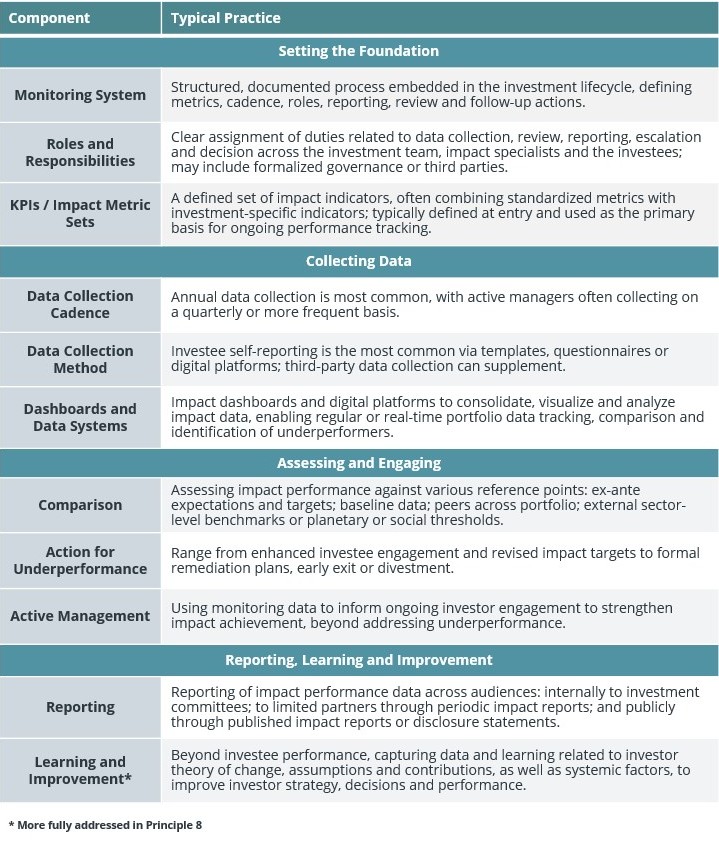
1. Institutionalizing structured monitoring practices. Most Signatories describe structured systems for monitoring impact performance, embedded in the investment lifecycle, that define indicators, data collection cadences and methods, and governance review and reporting processes. These processes are linked to the results frameworks and expected impact established under Principle 4, creating a feedback loop between ex-ante and ex-post impact assessments (See Exhibit 6a).
Exhibit 6a. Key Components of Impact Monitoring Practice
2. Combining standardized and bespoke indicators. Many Signatories are blending standardized metrics — most commonly drawn from the GIIN’s IRIS+ — with investment-specific indicators. Standardized metrics support portfolio-level aggregation, LP reporting and comparison. Bespoke indicators capture the most material and context-relevant impact results of a given investment. This hybrid approach reflects the practical tension between comparability and contextual relevance, and the recognition that striking the right balance is key to a robust monitoring practice.
3. Use of impact dashboards and digital data platforms. Automated data management systems, digital platforms and impact dashboards help consolidate, analyze and communicate impact data, serving both internal portfolio management and external reporting functions. These tools range from proprietary platforms developed in-house to third-party solutions that collect and aggregate investee data into portfolio-level analysis and visualizations. They enable investment teams to track impact performance in real-time and identify broad patterns as well as specific underperformers that require responses. The use of technology helps to systemize data collection and reduce reporting burden, enabling more robust and scalable impact monitoring.⁵
4. Formalizing processes for responding to impact underperformance. Signatories are using a range of processes and mechanisms for responding when monitoring indicates that an investment is not on track to achieve its intended impact. Documented actions span from enhanced investee engagement and revised impact targets to formal escalation, remediation plans and, in some cases, early exit or divestment. Investee engagement is a common approach Signatories use to manage underperformance, working with the investee’s management team to diagnose causes for underperformance and agree on corrective measures. More formal processes — such as defined thresholds, scoring triggers and governance review mechanisms — are less prevalent but present among some Signatories with systematic impact scoring or rating systems.
5. Portfolio-level impact aggregation. Despite the structural and methodological challenges, particularly when aggregating across diverse sectors and geographies or managing data misalignment issues, many Signatories describe aggregating impact data at the portfolio, strategy or fund level to enable portfolio-wide analysis, reporting and learning.
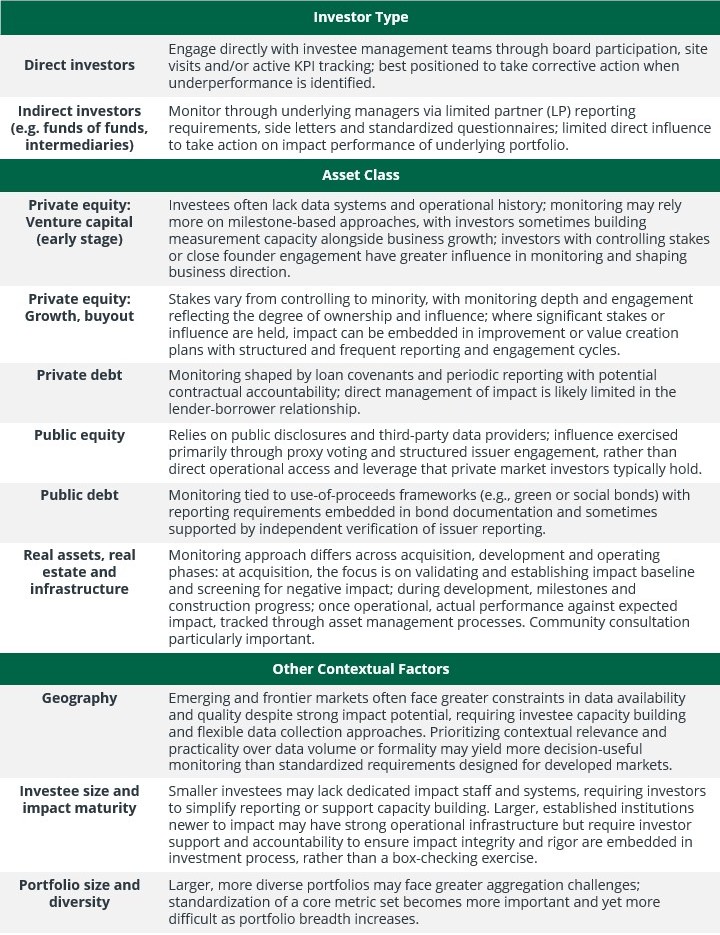
6. Variation in monitoring approach by investor type and investee context. Monitoring practices can vary across investors and are shaped by investor type, asset classes, impact theme and the structure of the investee relationship (See Exhibit 6b).
Exhibit 6b. Variation in monitoring approach by investor type, asset class and other contexts
Common, Emerging and Nascent Practices in the Implementation of Principle 6
Note: The findings and observations are primarily based on analysis of the most recent 166 Signatory disclosure statements at the time of the review, published in 2024 and 2025.
The disclosure analysis suggests that impact monitoring under Principle 6 is becoming a more established practice as a management process. Most Signatories now describe structured systems for tracking impact performance, e.g. defining indicators, collecting data on a regular cadence and comparing actual results against expectations. A notable feature of this maturing practice is the effort to balance standardized indicators for portfolio-level aggregation and comparability with bespoke indicators that capture investment-specific contexts. Many Signatories are also linking monitoring to accountability and engagement, identifying underperformance and responding with appropriate follow-up actions. At the same time, beneficiary feedback and outcome-level measurement remain nascent practices and point to areas for continuous development of monitoring practice.

Common Practices
(50 to 100% of disclosures)
- Impact metrics or KPIs used for monitoring. Ninety-four percent of Signatories disclose having impact indicators they track at portfolio or investment levels. Sixty-eight percent of Signatories provide examples of specific metrics or KPIs used to track impact performance in their disclosures.⁶
- Structured monitoring system or process. Ninety-three percent of Signatories describe a structured monitoring system or process in their disclosures, outlining how impact performance is tracked post-investment. These systems typically specify indicators, data collection cadence and method, roles, governance and reporting arrangements, with 8% of Signatories providing a visual representation of such a monitoring framework.
- Comparing progress to expected impact. Seventy-seven percent of Signatories disclose comparing impact progress against ex-ante expectations or targets as part of the monitoring process, creating a feedback loop between expected and actual performance. This comparison may also feed into more formal, documented review processes, tracking progress and capturing lessons learned to improve future decisions and processes.
- Using standardized metrics. Seventy-two percent of Signatories disclose using standardized metrics for portfolio, fund or investment-level impact, most commonly drawn from IRIS+, HIPSO, Joint Impact Indicators and 2X Global. Many combine the use of standardized metrics with customized, bespoke metrics to reflect the strategy and investment-specific contexts.
- Portfolio-level indicators and data aggregation. Seventy-two percent of Signatories disclose having portfolio, strategy or fund-level metrics that are monitored regularly and aggregated for internal portfolio management and external reporting.
- Predefined data collection method or cadence. Seventy percent of Signatories describe a predefined method for collecting impact data from investees, often including standardized questionnaires, reporting templates or digital platforms. Seventy-one percent disclose having annual data collection and monitoring, while 41% disclose collecting data quarterly.
- Pursuing appropriate action in response to underperformance. Fifty-four percent of Signatories disclose a process or mechanism for responding when monitoring indicates that an investment is not on track to achieve its intended outcomes. Responses range from enhanced investee engagement and revised targets to formal remediation plans and, in extreme cases, early exit or divestment.

Emerging Practices
(25 to 50% of disclosures)
- Using data reporting systems and dashboards. Forty-eight percent of Signatories disclose the use of data reporting systems, impact dashboards or digital platforms to consolidate, analyze and communicate impact performance data. These technology-enabled systems enable investment teams to more efficiently and effectively visualize performance trends, compare investments across the portfolio and generate impact reports.
- Capturing investment outcomes. Thirty-four percent of Signatories disclose monitoring outcome-level data or capture outcome indicators within their results framework, moving beyond simple output-level indicators. Outcome measurement typically relies on more intensive methodologies, including beneficiary surveys or independent assessments. Where direct outcome data is not yet feasible, some investors use proxy measures embedded in the results framework as reasonable indicators of expected outcomes.
- Customized, context-specific indicators. Thirty-one percent of Signatories explicitly describe using customized or context-specific indicators at the investment or portfolio level, tailored to reflect the most material and relevant impact outcomes in a given context. These bespoke indicators complement standardized metrics by capturing aspects of impact that standardized frameworks do not cover.

Nascent Practices
(<25% of disclosures)
- Sharing monitoring data with investees. Twenty-three percent of Signatories disclose sharing impact data collected through monitoring back with investees, creating a feedback loop that supports investee learning, ownership and continuous improvement.
- Third-party monitoring. Nineteen percent of Signatories disclose the use of external advisors or third parties to conduct or support impact monitoring. Third-party monitoring arrangements span a spectrum, from the operational outsourcing of routine data collection or monitoring functions, to the use of specialist outcome measurement platforms, to the commissioning of independent impact evaluations or external audits of impact data.
- Customer and stakeholder surveys. Eleven percent of Signatories disclose collecting feedback from customers, beneficiaries or other external and internal stakeholders, such as investees, ecosystem partners and employees.⁷
Principle 6 Signatory Practice Spotlights
-

Asset Class: Venture Capital and Private Equity
Clime Capital provides early-stage development and scale-up capital to accelerate the low-carbon energy transition in Southeast Asia, particularly in Vietnam, Indonesia and the Philippines. Clime Capital has developed a comprehensive impact monitoring system to dynamically monitor impact against milestones and prior performance.
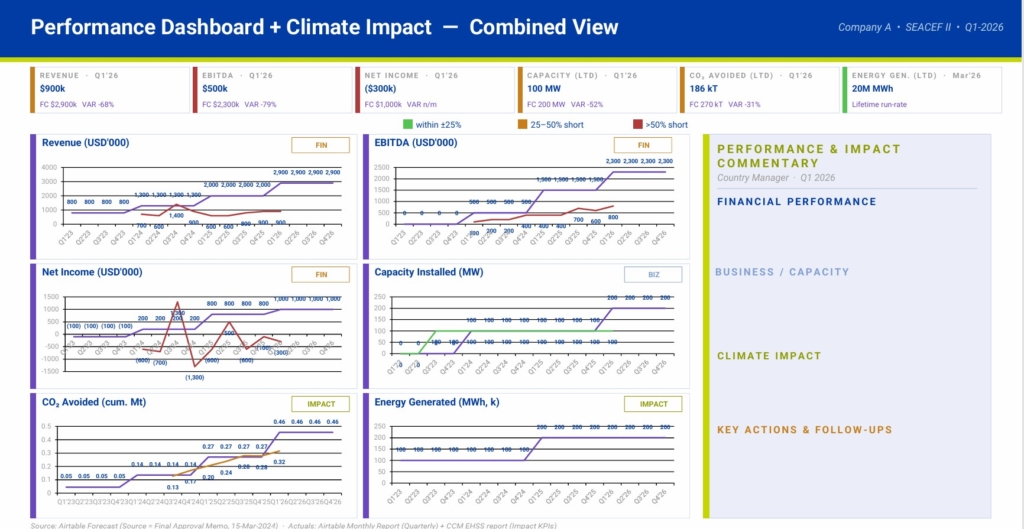
- Quarterly and monthly impact performance monitoring: Clime Capital’s monitoring process relies on quarterly impact and performance reports that track key performance data for each company, including installed capacity, carbon dioxide offset and the number of jobs created (See practice example 6.1). In addition, investee companies provide monthly updates that record milestones achieved compared to the previous month.
- Multi-year monitoring and portfolio comparison using KPI dashboards. Clime Capital uses its internal management information system (MIS) to monitor and analyze impact across its portfolio. Using dashboards, the MIS captures monthly and annual values for each KPI. The MIS supports real-time performance tracking, multi-year monitoring and cross-company comparisons against forecasted targets, enabling Clime Capital to identify trends and take corrective actions where needed.
- Traffic light system for impact performance tracking: Clime Capital uses a traffic light (green/yellow/red) system to track the status of each portfolio company’s impact performance. This simple visualization tool provides investment teams with an immediate, at-a-glance view of which companies are on track (green), require attention (yellow) or are underperforming and require active engagement (red).
- Escalation and response to underperformance: Where monitoring indicates underperformance, Clime Capital may engage with the company to address the issues and, in extreme cases, may divest from the project.
Practice Example 6.1
Clime Capital’s Company-level Integrated Financial and Impact Performance Dashboard
Asset Class: Venture Capital and Private Equity
Founded in 2020 and based in Tokyo, GLIN Impact Capital is an impact investment firm focused on addressing environmental and social challenges while advancing the impact ecosystem in Japan. GLIN has developed a proactive monitoring and engagement approach that combines a structured internal KPI tracking system and reporting guidance with third-party outcome measurement, while promoting a learning-oriented environment.
- Systematic KPI tracking and reporting guideline: GLIN tracks KPIs through a centralized management framework with periodic review processes, integrating impact monitoring with operational and financial updates. Supported by standardized reporting templates, portfolio-wide protocols and a dedicated KPI tracker for each investee, this structured approach enables consistent portfolio oversight while accommodating diverse impact pathways across individual investments. GLIN’s reporting framework outlines:
-
- Intended outcomes of each investment
-
- KPIs to assess whether the investment is on track to achieve the outcomes
-
- Frequency of data collection (ranging from monthly to annually)
-
- Data collection responsibilities and identified data sources
-
- Data quality controls and verification processes, where necessary
-
- Communication of impact performance to stakeholders
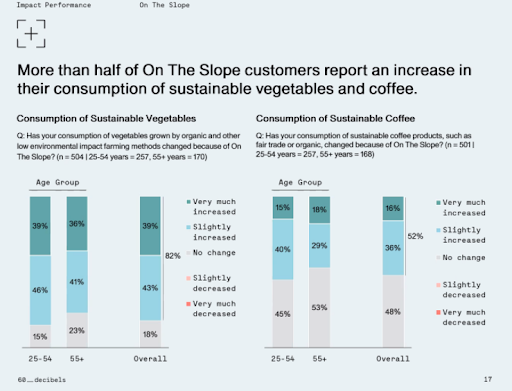
- Third-party outcome measurement: To strengthen its data credibility and stakeholder-centered insight, GLIN has introduced third-party outcome measurement in partnership with 60 Decibels, using its Lean Data methodology to capture feedback and outcomes directly from end stakeholders (See practice example 6.2).
- Proactive engagement with a learning orientation: GLIN regularly checks in with portfolio companies to review KPI progress, discuss challenges and identify improvement opportunities. Where performance falls short, it works with investees to co-develop adaptive responses, including setting new actions or revising targets. GLIN also promotes learning by sharing best practices and benchmarking insights across the portfolio, and in some cases introduces external experts, potential partners or follow-on investors to help accelerate impact and commercial progress.
Practice Example 6.2
Example of GLIN’s Outcome Reporting from Stakeholder Surveys
Asset Class: Private Debt and Private Equity
Impact Bridge is a Spanish impact fund manager focused on private debt investments that advance human dignity, including basic needs, financial inclusion, gender equity, employment and environmental sustainability. Its monitoring approach combines KPI tracking, impact covenants, continuous investee engagement, multi-format reporting and annual review of its proprietary Impact Bridge Impact Scoring Tool (IBIST®).
- KPI tracking and continuous engagement: Impact Bridge tracks quantitative and qualitative KPIs including IRIS+ and ad hoc metrics which vary depending on the impact theme and particularities of each investment and are aggregated for portfolio-level results. KPIs are updated quarterly, with ongoing, progressive interaction with investees through monthly, quarterly and annual reviews.
- Annual impact score review: Alongside KPI monitoring, Impact Bridge conducts an annual review of IBIST, its proprietary scoring tool assessing three core dimensions — beneficialness, intentionality and measurability — with 66 structured inputs to calculate a composite impact score. The review helps track performance over time and is shared with investees to highlight strengths and improvement areas.
- Impact covenants in loan documentation: For its flexible private debt fund (IB Deuda Impacto España), specific impact objectives are embedded in loan documentation through impact covenants. Portfolio companies report annually on progress against these covenants, allowing Impact Bridge to assess whether agreed upon impact objectives are being met and, where relevant, to discuss corrective measures or potential impact on future investment.
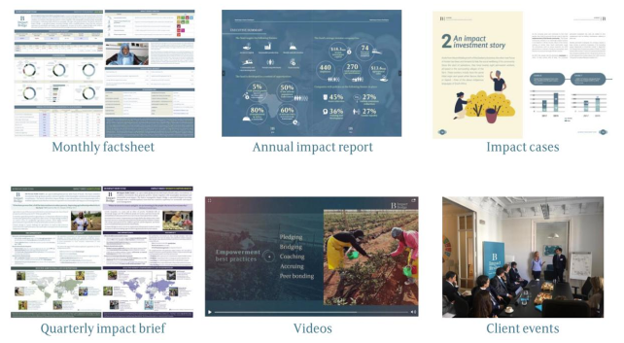
- Multi-format reporting and qualitative assessment: Monitoring outputs are communicated to investors through multiple formats, including monthly factsheets, annual impact reports, impact cases, quarterly impact briefs, videos and client events (See Practice Example 6.3). Complementing this, Impact Bridge integrates qualitative evaluations through academic collaborations and case studies to capture hard-to-quantify outcomes, reassess investments, test impact theses in real-world contexts and refine its understanding of systemic impact.
Practice Example 6.3
Impact Bridge’s Integrated Impact Reporting Suite for Investor Engagement
Asset Class: Venture Capital and Equity
MPM BioImpact is a biotechnology investment adviser making private and public equity investments into companies that translate scientific discoveries into breakthrough therapies for patients with unmet medical needs. Often making early-stage investments and focusing on the biotechnology sector, the firm centers its metric selection, target setting and monitoring on the drug and technology development timelines, adapting IMM best practices to its specialized investment context. MPM BioImpact endeavors to bridge patient-centric outcomes with impact-oriented frameworks.
- Tailoring targets to the biotech lifecycle: MPM BioImpact sets impact targets in partnership with portfolio companies at the time of investment, including both short-term development priorities and medium-term milestones. Given the early-stage biotechnology context, impact targets are highly bespoke and tailored to each company’s specialization and trajectory, often focusing on critical clinical milestones, such as initial tolerability and efficacy indicators.
- Monitoring through structured reviews and dashboard tracking: Progress is monitored through regular (typically annual) reviews, with impact data captured in a proprietary Portfolio Impact Dashboard. This monitoring enables ongoing performance tracking and identification of opportunities for individualized support, leveraging the firm’s expertise in R&D, clinical strategy and regulatory affairs.
- Governance engagement in public equity portfolio: For publicly listed portfolio companies, MPM BioImpact monitors key impact milestones and, as a voting shareholder, participates in all shareholder votes in accordance with its policies toward its impact philosophy.
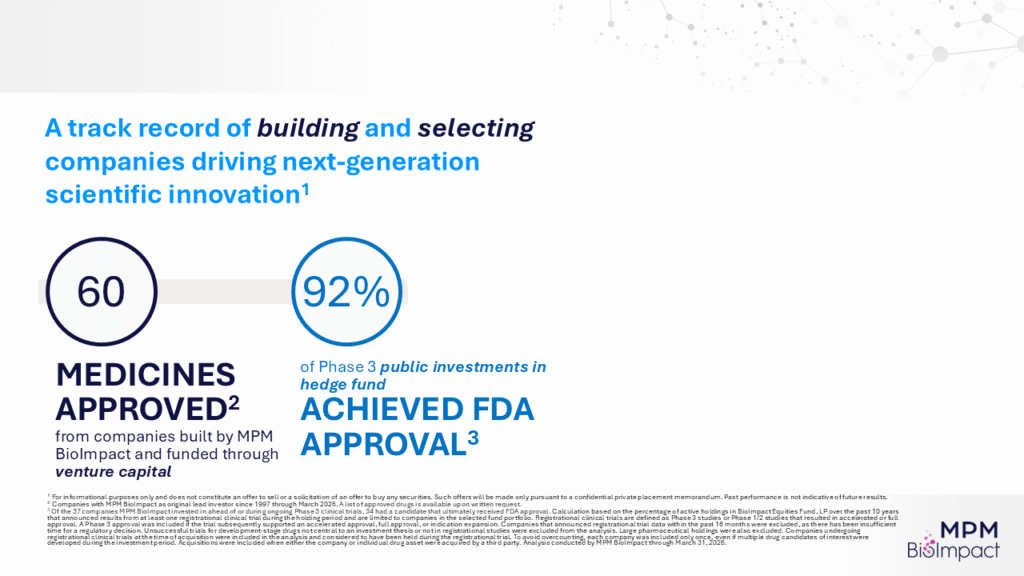
- Validating sustained impact through post-exit monitoring: MPM BioImpact continues to monitor portfolio companies post-exit, collecting data on drug approvals to assess whether its investments translated into improved patient outcomes and expanded options in critical unmet medical needs, providing a feedback loop that helps it refine its future investment approach for maximizing impact (See Practice Example 6.4).
Practice Example 6.4
Example of MPM BioImpact’s Post-Exit Monitoring

Asset Class: Venture Capital
Quona Capital is a venture and growth equity firm investing in fintech across dynamic markets, backing companies that expand access to financial services for underserved consumers and small businesses. Its strategy targets opportunities where social and financial drivers are mutually reinforcing. Quona monitors performance using impact scoring, regular reporting and reviews, and stakeholder outcome data.
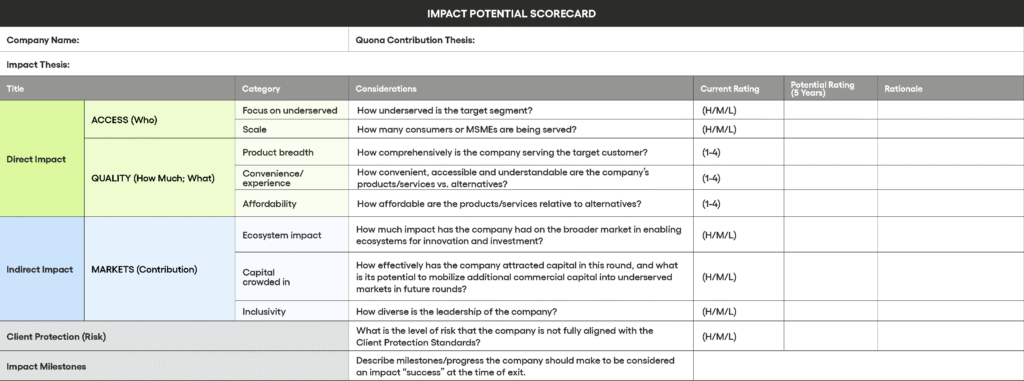
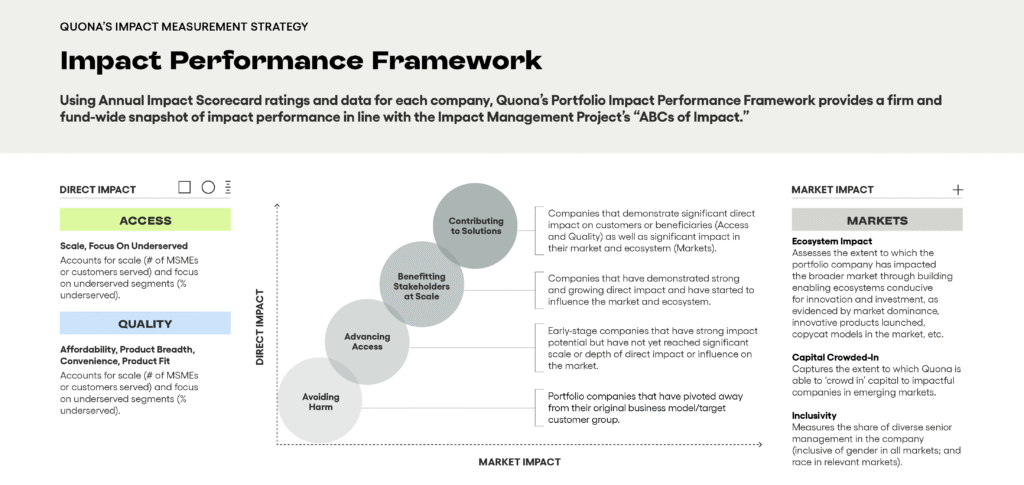
- Standardized monitoring through Impact Scorecards and annual reviews: Quona uses its industry-aligned impact framework and Impact Scorecards from pre-investment through the investment lifecycle, assessing company-level direct and indirect impact performance and potential for all new and follow-on investments (See Practice Example 6.5). As part of Quona’s Annual Impact Performance Review cycle, year-end Impact Scorecards are completed for each core portfolio company to assess and categorize company and fund-level impact performance, including underperformance, in line with the ABCs of Impact.
- Maintaining real-time visibility through monthly KPI reporting: In addition to its annual impact reviews, Quona requires portfolio companies to report monthly on impact KPIs. Quona itself reports to LPs quarterly at the investee, fund and aggregate levels. This high-frequency reporting allows Quona to track the progress of each investment against the theory of change and KPIs established during the initial investment process (See Practice Example 6.6).
- Validating real-world impact with stakeholder outcome data: Beyond traditional KPI tracking, Quona has partnered with 60 Decibels since 2021 to conduct voice-of-the-customer surveys with end users at select portfolio companies each year. This incorporates outcome-level stakeholder data into its monitoring process and provides direct insight into how its portfolio companies are improving the lives of their customers.
Practice Example 6.5
Quona’s Impact Scorecards
Practice Example 6.6
Quona’s Impact Performance Review Process

Asset Class: Private Equity and Private Debt
Sarona Asset Management is a global private investment firm, based in Canada, investing for impact in frontier and emerging markets, primarily through funds of funds and co-investments. In addition to its own funds, Sarona serves as investment manager for Australian Development Investments (ADI), which supports first-time and women-led fund managers in the Asia-Pacific region. Its impact monitoring approach combines a structured, metrics-based results framework with distributed data collection, centralized analysis and validation, and active portfolio-level reporting and capacity building.
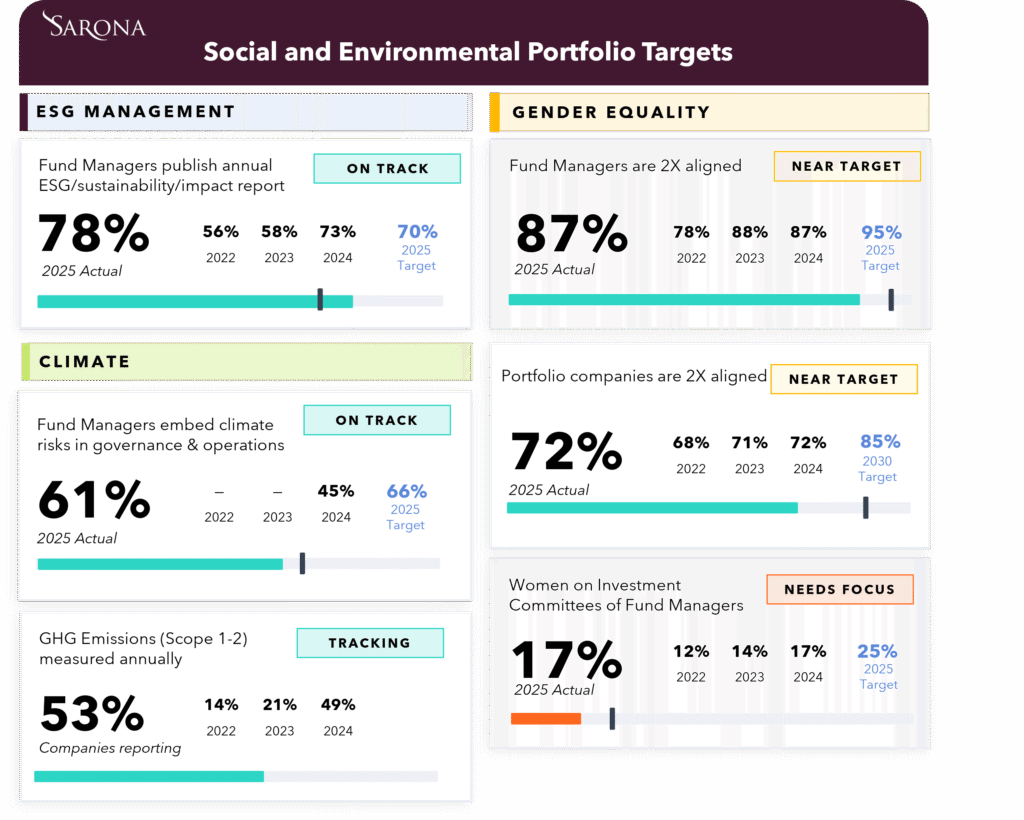
- Systematic impact monitoring and portfolio-level analysis: Sarona identifies impact KPIs for each investment based on its impact thesis and context, using a structured results framework drawing on IRIS+ metrics, 2X Criteria and the Joint Impact Model (JIM)⁸. Using a consistent, systematic monitoring framework allows Sarona to assess impact performance against expectations for each investment and to aggregate and analyze it at the portfolio level (See Practice Example 6.7).
- Distributed monitoring responsibilities, centralized oversight: As a fund of funds, Sarona relies on local investment partners to collect and report impact data from their portfolio companies under contractual monitoring requirements. Sarona’s investment team reviews, validates and aggregates data, while its impact team conducts JIM analysis, tracks progress and develops impact reports. Sarona’s investment committee oversees material deviations and responses.
- Multi- channel stakeholder reporting: Sarona reports its impact to stakeholders through public portfolio-wide impact reports, mandate-specific annual reports, quarterly investor calls, meetings of its Limited Partner Advisory Committee (LPAC) and case studies on its website.
- Capacity-building to strengthen monitoring: To ensure high-quality monitoring among its investee funds, Sarona provides these partners with the tools and support needed to improve their internal impact policies and processes, including through co-developed toolkits and dedicated technical assistance facilities.
Practice Example 6.7
Snapshot of Sarona’s Portfolio-level Impact Dashboard
Asset Class: Debt and Equity
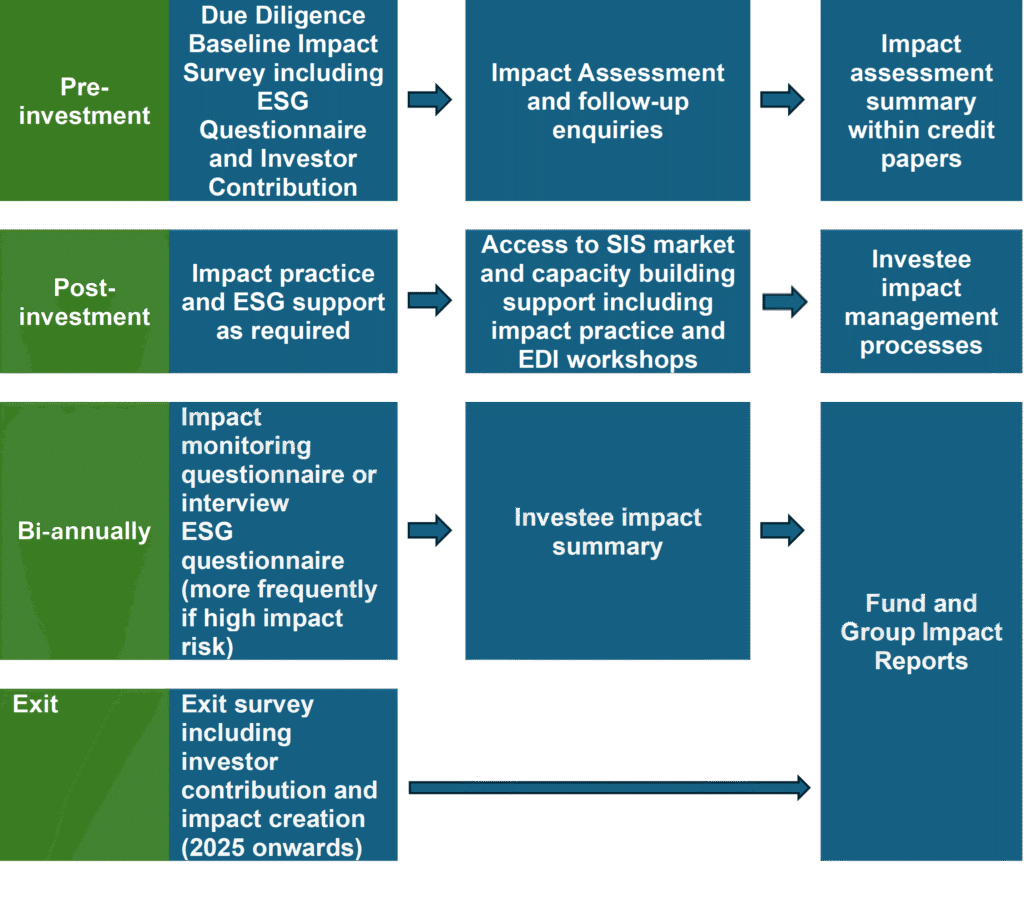
SIS is a social enterprise and charity that provides loan funding, equity investment (historical) and business support to UK-based social enterprises and impact-led businesses with a vision of advancing an impact economy. SIS’s monitoring process is part of its strategic impact management, which begins at due diligence, where SIS works with investees to understand current and intended impact, and continues through structured post-investment monitoring against planned impact creation.
- Strategic impact management across investment lifecycle: The strategic impact management approach at SIS combines pre-investment baseline assessment, post-investment impact planning, ongoing monitoring and board-level review, providing a structured process for comparing actual performance against initial plans and supporting impact management over time. SIS aggregates impact data to assess portfolio impact relative to overall objectives (See Practice Example 6.8).
- Monitoring against baseline assessment and initial plan: SIS Ventures, a wholly owned subsidiary of SIS, is not currently making new investments. In previous years, for new equity investments, SIS Ventures developed an impact and risk management plan, informed by full due diligence impact assessment and developed collaboratively with each portfolio company, within 100 days of investment. The plan includes a finalized theory of change, impact KPIs, data collection and reporting mechanisms, and it forms a baseline from which progress will be measured.
- Structured monitoring across multiple touchpoints: SIS tracks progress of investments through defined activities throughout the year, including periodic impact and risk assessments, board meetings, annual Impact Reports for portfolio companies and investor reporting. Two-year (as in every other year) monitoring processes are formalized, conducted and coordinated by the SIS Impact Team. Data collection may be conducted through an online survey or monitoring meetings with Investment Managers. An agreed template is used to gather responses, develop support needs, plan adjustments and identify future actions.
Practice Example 6.8
SIS Communities’ Strategic Impact Management Framework

Asset Class: Private Equity
SPE Capital Partners is a growth-stage private equity manager investing in controlling and quasi-controlling stakes in high-impact sectors — including healthcare, education, financial services and manufacturing — across North and West Africa. SPE Capital applies a systematic impact measurement and management (IMM) framework across its portfolio, using a formal scoring methodology to track performance over time. The approach is embedded in investment decision-making and tied to an impact action plan, with ongoing monitoring and fund-level aggregation enabling portfolio oversight and course correction.
- Standardized and company-specific KPIs: KPIs are identified at entry in collaboration with portfolio company management. A consistent set of transversal KPIs is tracked across the portfolio, covering employment, gender-disaggregated workforce composition by seniority, training, occupational health and safety, and resource consumption, climate stewardship alongside company-specific indicators aligned with IRIS+. KPI collection and analysis are done via a digital platform.
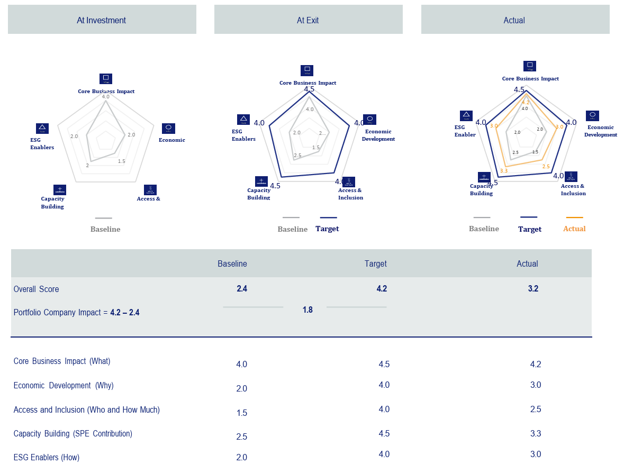
- IMM Scorecard across the investment period — baseline, target and actual: SPE Capital’s proprietary IMM Scorecard produces three scores for each investment: a baseline at investment entry, a target at exit and an actual score to track progress throughout the holding period. Each portfolio company’s impact score is updated annually through a formal impact performance review, creating a systematic feedback loop between monitoring data and investment management decisions (See Practice Example 6.9).
- Fund-level aggregation, gap analysis and remediation: Annual IMM scoring updates enable gap analysis across scores, while fund-level aggregation produces a portfolio-wide score that surfaces areas requiring additional effort. Where gaps are identified, SPE Capital may adjust company strategy, operations or organizational structure, establishing a remediation timeline and specific performance targets.
- Ongoing monitoring of the impact action plan: Progress against the impact action plan is monitored on an ongoing basis through regular meetings attended by the deal and portfolio management teams. Together, they review achievement against the plan, adjust decisions and integrate improvements on a rolling basis.
Practice Example 6.9
Illustrative Impact Score Snapshot: Baseline, Target, and Actual Performance

Asset Class: Private Equity
TowerBrook Capital Partners is a global private equity firm whose Delta impact strategy prioritizes collinearity between impact and financial performance. Investing across Europe and North America, it targets businesses whose ability to generate measurable impact outcomes for the planet (including energy transition, decarbonization, and resource sustainability) and/or people (including health and well-being, education, and financial inclusion) is central to their core business models. By backing businesses with revenues that are already tied to impactful work, TowerBrook is able to intertwine impact and value creation when assessing plans to accelerate business performance.
- Combining standardized and bespoke KPIs: TowerBrook combines company-specific, sector-relevant impact KPIs with portfolio-wide metrics aligned with leading industry and regulatory requirements (e.g., IRIS+, HIPSO, Joint Impact Indicators, EU SFDR), balancing comparability, compliance and flexibility. It works closely with management teams to establish and track KPIs, building buy-in and identifying opportunities to enhance impact performance.
- Operationalizing impact through value creation (200 Day Plan): At investment, TowerBrook develops an impact-oriented purpose statement for each company and launches a 200-Day Plan that identifies value creation initiatives, including impact-specific strategic opportunities. This establishes impact monitoring as a business priority from the outset.
- Structured monitoring through quarterly valuation and PCRS processes: TowerBrook monitors the impact performance of each portfolio company four times a year through its valuation and Portfolio Company Review and Support (PCRS) processes, covering financial, operational, and impact KPIs. Impact is also reviewed as part of the twice-yearly Investment and Midcycle Review, Exit Readiness (IMEX) process, providing a structured opportunity to reevaluate the investment and impact thesis and exit strategy, update the value creation plan, and assess impact performance and the completion of action plans.
- Integrated impact and financial performance tracking: TowerBrook uses an Impact Intensity Ratio (IIR) to measure impact output per financial unit, tracking impact relative to financial returns. In line with its collinearity strategy, it views rising IIR positively, while declining IIR is treated as a risk requiring intervention.
Footnotes
¹ For more on challenges related to standardization versus contextualization, read Principle 2, Principle 4 and Principle 8 Common and Emerging Practices.
² Learn more by reading the Principle 8 Common and Emerging Practices.
³ For more on challenges related to assessing and measuring outcomes versus outputs, read Principle 4 and Principle 8 Common and Emerging Practices.
⁴ GIIN 2025 survey findings related to IMM metrics and practice (unpublished)
⁵ For more observations on enabling technology and tools, read the Principle 2 Common and Emerging Practices.
⁶ Also see Principle 2 Common and Emerging Practices.
⁷ Also see Principle 8 Common and Emerging Practices.
⁸ https://www.jointimpactmodel.org